It was only November 2022 when OpenAI released ChatGPT, introducing the world to a generative AI capable of crafting text, speech, and images on demand. It sparked a genuine revolution because, suddenly, we were interacting with technology in a way that felt remarkably human, opening a door to endless possibilities.
Today, businesses, organizations, and governments are all asking the same thing: How do we actually harness this potential?
Integrating AI is not just a trend; it is a way to sharpen decision-making, boost efficiency, and accelerate growth. However, the real challenge isn’t the AI itself. Instead, it is ensuring your organization is truly ready for it. The opportunity lies in meeting your organization where it is today by identifying your current digital maturity and building the systems that allow AI to thrive natively within your workflow.
The Pillars of Digital Readiness
Your ability to leverage AI is directly tied to your organization’s digital readiness. Generally, the more digitized your systems and tools are, the more deeply you can integrate AI into your core operations. For those earlier in the journey, your AI “wins” might look a bit different. A great starting point for a developing organization is a change management initiative that encourages team members to use GPT models to streamline their daily tasks.
At Pathworks, we utilize a proven framework built on four essential pillars:
- Strategy and Leadership: Digital is the heartbeat of the core business strategy, led by tech-forward pioneers.
- Culture and Mindset: Embracing agility, a growth mindset (shifting from “I don’t know” to “I haven’t learned yet”), and radical collaboration.
- Data-Driven Decision Making: A robust infrastructure that predicts needs rather than just reacting to the past.
- Experience and Personalization: Using technology to remove friction for both external and internal customers.
The 5 Levels of the Digital Maturity Model
While these pillars provide the framework, we track progress through five distinct levels. It is important to note that maturity isn’t always uniform; an operations department might be highly enabled while a laboratory remains manual. Identifying where each area of your business resides is the first step toward true integration.
Level 1: Traditional
At this stage, processes are manual and data lives in isolated “Excel islands” on individual desktops. There is no central technology strategy, and the culture often views digital change as a threat.
- The Breaking Point: A crisis, such as a competitor launching a superior app or a massive data loss, proves the “old way” is no longer sustainable.
Level 2: Managed and Opportunistic
The company recognizes that digital matters, creating “pockets of excellence.” Marketing might have a great CRM, while Finance still relies on paper. Cloud adoption begins, but platforms do not talk to each other yet.
- The Breaking Point: Inefficiency. Leadership realizes they are paying for multiple tools that do the same thing while data remains inconsistent across departments.
Level 3: Integrated
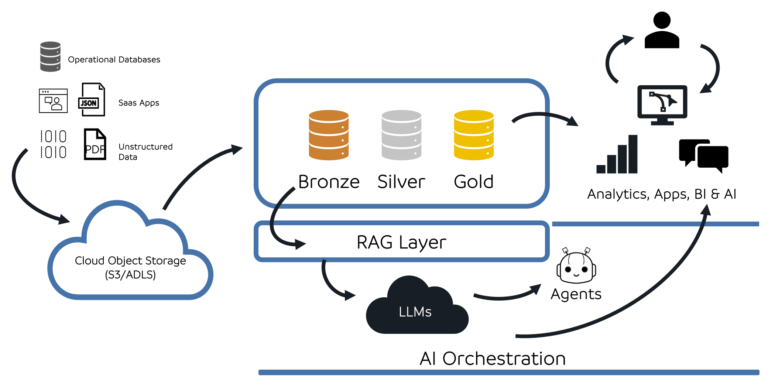
The focus shifts to a unified data fabric. Systems are connected via APIs, and a centralized “source of truth” such as Snowflake or BigQuery is established. Data is available, but the sheer volume begins to overwhelm human analysis.
- The Breaking Point: Complexity. The data becomes so vast that humans can no longer analyze it fast enough to make real-time decisions.
Level 4: Data-Driven
The organization stops looking in the rearview mirror and starts looking through the windshield. AI and Machine Learning optimize existing processes like predictive maintenance or dynamic pricing. The culture is agile, utilizing cross-functional sprints.
- The Breaking Point: Scaling. To grow further, the company needs systems that can act autonomously without waiting for a human to click a button.
You can reference our Real-time Dashboards article to learn more about one of our primary data-driven tools.
Level 5: Transformational (AI-Enabled)
In 2026, this is the realm of Agentic AI. Technology is the engine that allows the organization to perceive, reason, and act with zero latency. The business becomes a living organism, sensing market changes and reconfiguring itself automatically.
- The Result: The workforce focuses entirely on strategy and ethics while the digital core handles the running of the business. The company doesn’t just respond to the market; it defines it.
Ready to Elevate Your Digital Maturity?
Understanding where you stand on the maturity spectrum is the difference between a failed AI experiment and a transformative business shift. At Pathworks, we specialize in helping organizations bridge the gap between “Traditional” and “Transformational” by aligning your data strategy with your long-term vision. More importantly, we provide the expertise needed to turn that vision into a tangible, high-performing reality.
Is your organization ready for the AI era? Reach out to us at Pathworks for a comprehensive Digital Maturity Assessment, and let’s build your roadmap to Level 5 together.
Further Reading & Resources
If you are interested in diving deeper into the frameworks that informed this roadmap, we recommend exploring these seminal studies and blueprints:
- Deloitte & TM Forum | Digital Maturity Model (DMM) The primary blueprint for the 5-dimension, 5-level organizational assessment. View the Full Model
- MIT Sloan Management Review | Achieving Digital Maturity A seminal study exploring how mature companies revamp their approach to strategy, talent, and leadership in the digital age. Read the Report
- IDC | MaturityScape: Digital Transformation 2.0 Official framework definitions detailing the essential transition from Ad Hoc processes to an Optimized, AI-ready state. Explore the Framework