
Currently, AI is the cherry on top of the digital transformation cake. It is a disruptive force that can boost efficiency and allow teams to deliver results in mere days that used to take months. It represents a quantum leap in the analytics realm; with the proliferation of advanced models, it has become easier than ever for AI to predict trends with surgical accuracy and even initiate actions autonomously.
But what exactly is driving this AI revolution? Most of us interact with AI daily, whether we realize it or not. It might be direct, like asking ChatGPT or Gemini to draft a document, or indirect, such as accepting a Netflix movie recommendation or having a credit card transaction flagged for unusual activity.
The Cake Analogy: If AI is the cherry, many organizations are trying to place it on a cake that hasn’t finished baking. You can have the best frosting and the most advanced decorations, but without a solid, well structured base, the whole thing collapses.
Every one of these interactions is fueled by data. Whether it is the vast, public information available on the internet or your specific historical preferences, AI is only as smart as the information it consumes.
So, how do we move beyond simply asking ChatGPT to review an email or a basic spreadsheet? How do we leverage the true power of AI within our specific industries? The answer is simple yet profound: Your AI can only go as far as your data allows it. > The Jet Engine Analogy: Think of it this way. AI is like a high performance jet engine. It has the potential to travel at incredible speeds, but if you feed it low grade fuel, or worse, if the fuel lines are clogged, that engine will never leave the runway.
To unlock true Agentic AI that makes decisions and solves problems, you first need to build a Modern Data Layer. This is the infrastructure that ensures your fuel is refined, high octane, and ready for ignition.
Data & AI Pillars
Let’s dive into the four data and AI pillars. They are embedded within each other, but each one serves a particular business purpose. These pillars are the intelligent foundation of a digitally enabled company.
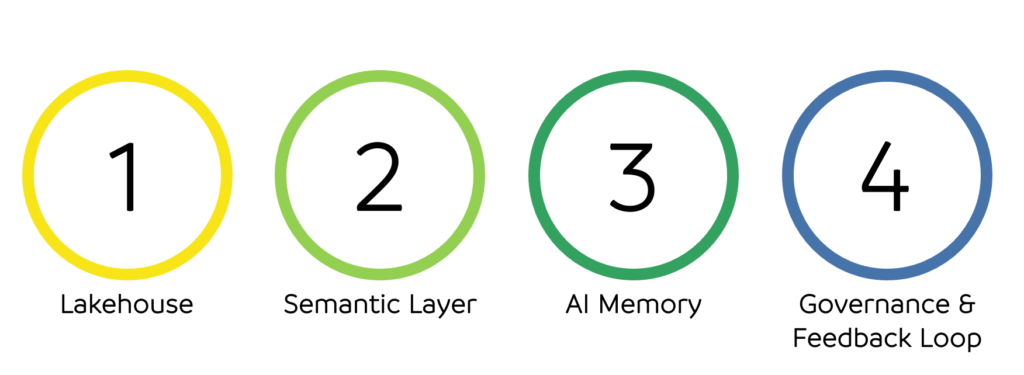
- Lakehouse: This is where the raw data from your different systems and machines will live. It’s the foundation of your data layer, and it will ensure that all your analytics tools will look at the same data. The lakehouse includes structured (tables from transactional systems) and unstructured (PDFs, call recordings, slack messages) data.
- Semantic Layer: This is the “translator” between complex code and business logic. It provides AI agents and analysts with standardized definitions for KPIs like “Revenue” or “Churn.” By encoding your business rules here, you prevent AI hallucinations and ensure that every automated insight is grounded in your company’s official logic.
- AI Memory: This is the “translator” between complex code and business logic. It provides AI agents and analysts with standardized definitions for KPIs like “Revenue” or “Churn.” By encoding your business rules here, you prevent AI hallucinations and ensure that every automated insight is grounded in your company’s official logic.
- Governance & Feedback Loop: This is the “translator” between complex code and business logic. It provides AI agents and analysts with standardized definitions for KPIs like “Revenue” or “Churn.” By encoding your business rules here, you prevent AI hallucinations and ensure that every automated insight is grounded in your company’s official logic.
Building a Data Layer
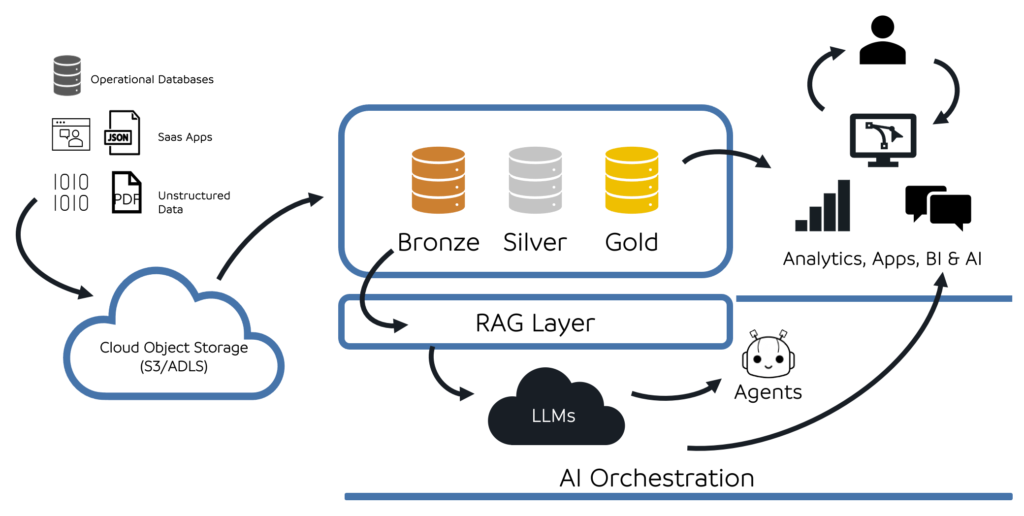
Step 1: Establish a “Lakehouse” Foundation
The first step in any modern intelligence strategy is centralizing your data. In the past, companies were forced to choose between two systems: the Data Lake and the Data Warehouse. Today, we bridge that gap with the Lakehouse.
To understand why this is the cornerstone of an AI-ready layer, we must look at how it evolves from its predecessors:
- The Data Lake:Historically, lakes were used to store vast amounts of “raw” data both structured (transaction logs) and unstructured (PDFs, images, and audio). They offered cheap, infinite storage but often became “data swamps” because they lacked organization and speed. They were the playground for data scientists, following an ELT (Extract, Load, Transform) approach where structure was only applied when someone actually needed to use the data.
- The Data Warehouse: In contrast, warehouses are highly organized filing cabinets. Data is cleaned and structured before it enters the system (ETL), making it perfect for high-speed business intelligence, dashboards, and financial reporting. However, they are often rigid, expensive, and struggle to handle the “messy” data that AI thrives on.
The Lakehouse: The Best of Both Worlds
A Lakehouse is a unified architecture that provides the low-cost, flexible storage of a Lake with the high-performance management and “ACID” reliability (ensuring data doesn’t get corrupted) of a Warehouse.
Why this matters for AI: In an AI-driven organization, your models need to “see” everything. An AI agent might need to cross-reference a structured SQL table of customer orders with an unstructured PDF of a shipping contract. In a traditional setup, those live in two different systems. In a Lakehouse, they live side-by-side.
By establishing a Lakehouse foundation, you ensure that your data scientists (building AI) and your business analysts (building reports) are looking at the exact same “Single Source of Truth.” This eliminates data silos and ensures that when your AI provides an answer, it is grounded in the same verified data used by your leadership team.
Step 2: Medallion Architecture
The medallion architecture organizes data in a lakehouse in different levels based on how structured data is:
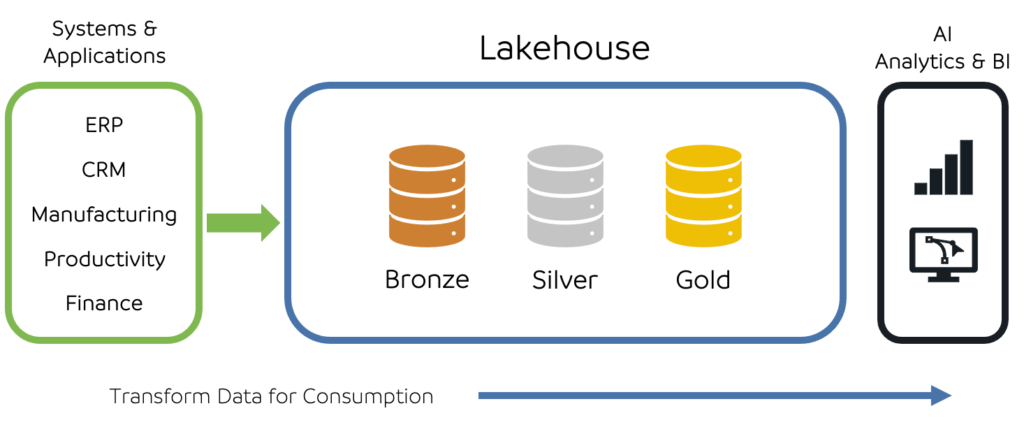
Data gets organized into tiers, enabling data scientists and business intelligence depending on the objective of different teams within the organization.
- Bronze Layer (Raw Data): The data exactly as it arrives from the systems, tables from transactional systems, PDFs, JSON logs and CSV files.
- Silver (Cleaned): Here, data is de-duplicated, normalized, and cleaned. It is the “workhorse” layer where different data sources are joined together into a consistent format.
- Gold (Business): Highly aggregated and business-ready. This is the organization’s “source of truth,” containing the verified metrics that drive board-level decisions.
Step 3: Unstructured Data Ingestion
Traditional analytics and business intelligence focus on tables that come from transactional systems, such as ERPs and CRMs. AI has the advantage of ‘understanding’ context, and this comes from different sources.
AI changes this by “reading” and “hearing” context. To enable true organizational intelligence, your ingestion must include:
- Knowledge Assets: SOPs, employee handbooks, and compliance reports.
- Communication Streams: Email threads and Slack/Teams messages.
- Meeting Intelligence: Transcripts from Zoom or Teams calls and signed legal contracts.
Step 4: Chunking and Embedding Layer
To make unstructured data “readable” for an AI’s brain (the LLM), we must translate human language into a format computers can process mathematically:
- Chunking: Slicing long documents into smaller, manageable “chunks” (e.g., 500-word sections) so the AI can pinpoint specific information without getting lost in a 100-page manual.
- Embedding: Each chunk is converted into a Vector, a string of numbers that represents its meaning. This allows the system to understand that a document about “Staff Turnover” is relevant to a query about “Retention,” even if the words don’t match.
The chunks and vectors are the backbone of RAG (Retrieval Augmented Generation) which is the next step of the process.
Step 5: RAG Layer or Vector Database
This step is a critical addition for AI. It is the ‘AI Database’, as it will store all the unstructured information in a semantic friendly format for AI.
An example would be like a librarian who has read every page of book and understands the concepts, so when a question is asked it looks for meaning rather than just words.
A RAG layer is needed for:
- Semantic Search (Meaning Based): Understanding that “Employee retention challenges” is conceptually related to “Staff turnover”.
- Speed at massive scale.
- Long term memory of AI.
Step 6: Semantic Layer
As we mentioned on the step 2, the gold layer hosts highly curated and aggregated data ready for business consumption. The semantic layer is the official metric store of a business. It stores and safeguards the accurate calculation of a business numbers.
In modern organizations, there could be several ways to calculate metrics, as systems might have the same information.
An example of this could be the yield calculation in a manufacturing company. The ERP holds the number of finished goods shipped to the customer, but the manufacturing system holds the defects found during the proces, creating two options to calculate the yield:
- ERP Yield: (Shipped Product) / (Starting Quantity)
- Manufacturing System Yield: (Starting Quantity – Defects) / (Starting Quantity)
In a perfect world these two calculations should match, but processes are way more complex in the real world, leading to a potential variation between those two. This is why is important to define a semantic layer to accurately calculate define and calculate the official metrics to be reported in a business.
Step 7: Governance and Feedback Loop
In an AI-enabled environment, data is constantly evolving. Governance is no longer a static set of rules; it is an active lifecycle of Traceability, Trust, and continuous Improvement. This pillar ensures that whether a decision is made by a CEO looking at a dashboard or an AI agent executing a task, it is based on verified, high-quality information.
Governance ensures that the data driving your business is accurate, timely, and secure.
- End-to-End Lineage: You must have a clear “paper trail” from the final KPI in a dashboard back to its raw source in the Bronze layer. If a revenue number looks wrong, lineage allows you to pinpoint exactly where the calculation or the data ingestion failed.
- Certified Data Products: Instead of a “Wild West” of thousands of unverified reports, modern governance creates “Certified” data sets. This tells users: “This table has been tested, documented, and approved by the Data Steward.”
- Access Control (ABAC): Using Attribute-Based Access Control, you can ensure that security follows the data. If a column is marked as “Salary PII,” it remains hidden whether it’s viewed in Power BI, a SQL editor, or an AI chat interface.
By combining BI and AI governance into a single pillar, we ensure that Trust is the foundation of your intelligence. When your data is governed, your AI is explainable, your dashboards are indisputable, and your organization can move with the speed and confidence required in the modern era.
The roadmap to an AI-enabled data layer is clear, but the first step is often the hardest. Whether you are struggling with fragmented data silos, inconsistent business metrics, or an AI strategy that lacks a solid foundation, Pathworks is here to help you navigate the complexity.